Handmade Catholic Rosaries and Jewelry

This the Blog where I share my faith, my Rosaries, and other good things!

Tuesday, January 4, 2011

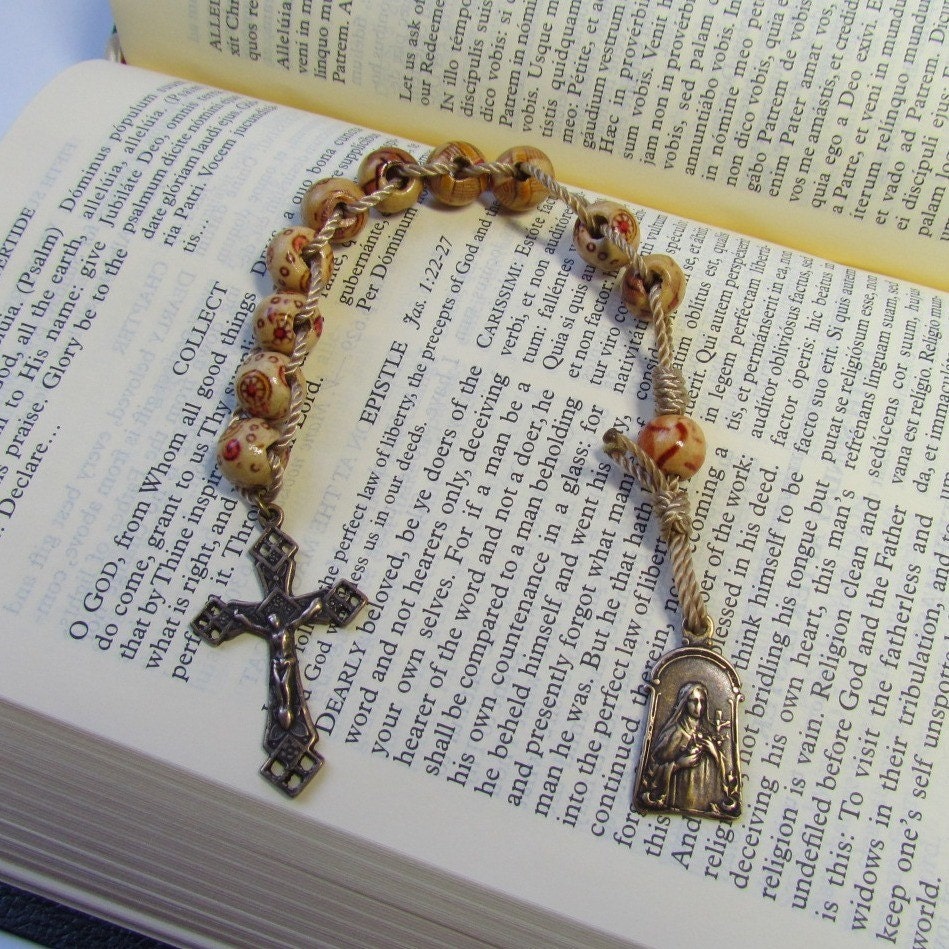
St. Therese Sacrifice Beads now in stock!


Back by popular demand.. St. Therese Sacrifice beads!
I have been unable to make these St. Therese Sacrifice beads, because my source for cord, FNT Industries, went out of business.  Amazingly, FNT seems to have been the only internet source for rosary cord!  No one else had colors or this size.  The internet buzz was one of distress and panic as corded rosary makers were scrambling to find an affordable source for their mission rosaries.

I would have just given up, except that Googlers kept requesting my beads!  (It feels so good to be loved:)  On the Feast of St. Therese (Oct 15) I felt too much heavenly pressure that I resolved to find a way!  I had to do an extensive search for cording, ordered many different kinds...a lot of trial and error...mostly error.  But finally, I have found it!

The gold thread is the color I will stock.
So here they are. Although I have several colors pictured, most of these strands were sample cord.  After these are sold, I will only be offering the gold corded beads.  As I use up some of that massive spool, I will be able to purchase other colors of cord.

These Sacrifice beads are even better than the originals.  I now have new medals, all solid bronze antique reproductions.  I am offering the beads at $13.00 per set. Visit Graceful Rosaries to purchase. I wish I could make them more affordable for children....but most of the cost is in  the medals. 

History of the Beads:
When St. Therese was a young girl she began the practice of counting out her acts of love for Our Lord, on a string of beads. You too can follow her example of holiness with this beautiful string of beads.

The Sacrifice Beads can also double as a one decade rosary. I have strung 10 beads for the Hail Mary's and 1 bead separated by knots, for the Our Father.

The beads are beautifully detailed wooden beads, strung on nylon cord. They slide easily when pushed up or down, yet they stay in their place when left alone.

Monday, December 27, 2010

Feast of the Holy Innocents

Our soul has been rescued like a bird from the fowler's snare.
Holy Innocents
by Christina Georgina Rossetti

Sleep, little Baby, sleep,
The holy Angels love thee,
And guard thy bed, and keep
A blessed watch above thee.
No spirit can come near
Nor evil beast to harm thee:
Sleep, Sweet, devoid of fear
Where nothing need alarm thee.

The Love which doth not sleep,
The eternal arms around thee:
The shepherd of the sheep
In perfect love has found thee.
Sleep through the holy night,
Christ-kept from snare and sorrow,
Until thou wake to light
And love and warmth to-morrow. 


Father, the Holy Innocents offered you praise by the death they suffered for Christ. May our lives bear witness to the faith we profess with our lips.

from the Directory of Popular Piety and the Liturgy: The Feast of the Holy Innocents
Giotto di Bondone
No. 21 Scenes from the Life of Christ
Massacre of the Innocents
1304-06 -- Fresco

Friday, December 24, 2010

O Emmanuel - Dec 23

Latin:
O Emmanuel, Rex et legifer noster,
exspectatio Gentium, et Salvator earum:
veni ad salvandum nos, Domine, Deus noster.
English:
O Emmanuel, king and lawgiver of us,
the hope of the nations and Saviour of them:
Come and save us, O Lord, God of us.
Well, we are finally at the last 'O Antiphon'  and the last liturgical day of Advent.  Notice that this antiphon begins like that Hymn that I gave yesterday.  I did not want to reveal the letter for the last antiphon, but in order that you could sing the song, I had to give that familiar verse.  I recommend that you add the first verse again at the end if you sing the song at home to celebrate the 'O Antiphons'.

Thanks again to Peter O's children for these pictures.
O Emmanuel: this is a fitting final title because of the prophecy (which you are familiar with in Matthew) which uses this name and because of the meaning of the name.  You may not be familiar with the original prophecy, where Isaiah was sent to meet King Achaz in the way:
Is. 7:10 And the Lord spoke again to Achaz, saying: 11 Ask thee a sign of the Lord thy God either unto the depth of hell, or unto the height above.  12 And Achaz said: I will not ask, and I will not tempt the Lord.  13 And he said: Hear ye therefore, O house of David: Is it a small thing for you to be grievous to men, that you are grievous to my God also? 14 Therefore the Lord himself shall give you a sign. Behold a virgin shall conceive, and bear a son, and his name shall be called Emmanuel. 15 He shall eat butter and honey, that he may know to refuse the evil, and to choose the good.
Modern scripture scholars say that all prophecies are of events current to the prophet's life. The idea being to explain away any miraculous happenings and so fit the interpretation of the Bible into the mold of modern science.   Modern science seems to have as a principle that the possibility of a God is not to be considered, even as part of a hypothesis. And so they say that the word virgin really just refers to a young woman -- because otherwise we would have a miracle -- and that the woman was already pregnant -- because otherwise the prophecy itself would be a miracle of predicting the future.   These people have no faith and their ability to read scripture even without faith is less than scientific, because they are not willing to consider the possibility of miracles.

The very context suggests that this is not what the prophet is saying;  "Ask thee a sign of the Lord thy God either unto the depth of hell, or unto the height above."  Would a young married woman having a baby be a sign "either unto the depth of hell, or unto the height above?"   How can this be the sign which the prophet is about to foretell? 
Besides what an embarrassing turn of phrase would it be to call the woman a "virgin" when the specific meaning was just a young woman.  If she was married she would not be old enough to pass over the term virgin to be called a wife/woman.  (Many ancient languages did not distinguish between wife and woman.) It was not Isaiah's style to make egregious grammatical errors for the sake of a trick.  It would be incorrect to refer to a married woman with a word for young women, which word also means virgin.  A different term for young women would have to be used.      
The evoking of this prophesy in our minds by the word 'Emmanuel' on this last day is appropriate because it concretely describes what is to take place in just a short time:  "A virgin shall conceive and bear a son."  It is also a name very directly attributed to Him - "His name shall be called Emmanuel." How wonderful it is that we, in praying this antiphon, fulfill the prophesy ourselves.
Finally, this is an appropriate final title because of the meaning of Emmanuel.  You will notice the "el" at the end of Emmanuel. This happens frequently like in the name Michael, Gabriel, Raphael, Israel, and Ishmael.  The word is added to the ends of Hebrew names and actually means 'God'.   So for example Michael means: "Who is like God".  Emmanuel means:  "God with us."  As so it is for the final 'O Antiphon' where we profess most clearly that Christ is God.  And at the end of the antiphon we pray for our most basic and universal want, "save us."  We punctuate the antiphons with an out and out profession for the sake of more merit, one final name:  "Our Lord and God."


And now for the code: with the final word Emmanuel we have an 'E' which gives us:  "Ero Cras."  Now some of you may have looked up or already know that Cras means tomorrow.  Ero is future verb and means: "I will come".  So the phrase is: "I will come tomorrow."   This secret phrase exhilarates us with expectation.  It is repeated in many different ways all morning and afternoon before first Christmas Vespers in the verses and antiphons :
(The Invitatory at Matins:) "This day ye shall know that the Lord cometh * and in the morning, then ye shall see His glory. (Verses at Matins and Antiphon throughout the day:) Sanctify yourselves to-day, and be ready for on the morrow ye shall see * The majesty of God upon you. Stand still, and ye shall see the help of the Lord with you O Judah and Jerusalem, fear not.* To-morrow ye shall go out, and the Lord will be with you.  On the morrow the sins of the earth shall be washed away, and the Saviour of the world will be our King. On the morrow * ye shall be saved, saith the Lord God of hosts. (Antiphon of the Canticle of Simeon at Lauds:)  Rise, he shall, * like the sun, the Savior of the world, and come down into the womb of the Virgin as the showers upon the grass. Alleluia.   
The prayer for the Vigil of Christmas is a prayer especially for all who have made a journey through the stations of the 'O Antiphons'.  God Bless you all.  I will end with the prayer.

God, who gladden us by the annual expectation of our redemption, grant that we who now joyfully welcome thy Only-begotten Son as our Redeemer, may also, without fear, behold him coming as our Judge.

O King of Nations - Dec 22

O King of Nations

We are almost done, so now we need to prepare for the final antiphon.  Remember that Vespers on the 23rd begins the liturgy for the next day, the Vigil of Christmas.  The next Vespers will be part of the last liturgical day before Christmas.  For those of you who do not sing Vespers or the "O Antiphons" there is a poor man's version of the Antiphons.  For those of you who cannot sing the 'O Antiphons', here are the lyrics to a song you can sing:

VENI veni, Emmanuel
captivum solve Israel,
qui gemit in exsilio,
privatus Dei Filio.
R: Gaude! Gaude! Emmanuel,
nascetur pro te Israel!
O COME, O come, Emmanuel,
and ransom captive Israel,
that morns in lonely exile here
until the Son of God appear.
R: Rejoice! Rejoice! O Israel,
to thee shall come Emmanuel!
Veni, O Sapi-en-ti-a,
quae hic disponis omnia,
veni, viam prudentiae
ut doceas et gloriae. R.
O come, Thou Wisdom, from on high,
and order all things far and nigh;
to us the path of knowledge show,
and teach us in her ways to go. R.
Veni, veni, Adona-i,
qui populo in Sinai
legem dedisti vertice
in maiestate gloriae. R.
O come, o come, Thou Lord of might,
who to thy tribes on Sinai's height
in ancient times did give the law,
in cloud, and majesty, and awe. R.
Veni, O Iesse virgula,
ex hostis tuos ungula,
de spectu tuos tartari
educ et antro barathri. R.
O come, Thou Rod of Jesse's stem,
from ev'ry foe deliver them
that trust Thy mighty power to save,
and give them vict'ry o'er the grave. R.
Veni, Clavis Davidica,
regna reclude caelica,
fac iter tutum superum,
et claude vias inferum. R.
O come, Thou Key of David, come,
and open wide our heav'nly home,
make safe the way that leads on high,
that we no more have cause to sigh. R.
Veni, veni O Oriens,
solare nos adveniens,
noctis depelle nebulas,
dirasque mortis tenebras. R.
O come, Thou Dayspring from on high,
and cheer us by thy drawing nigh;
disperse the gloomy clouds of night
and death's dark shadow put to flight. R.
Veni, veni, Rex Gentium,
veni, Redemptor omnium,
ut salvas tuos famulos
peccati sibi conscios. R.
O come, Desire of the nations, bind
in one the hearts of all mankind;
bid every strife and quarrel cease
and fill the world with heaven's peace. R.


I will not give you the last verse.  I hope you see how verses 2-7 correspond with the 'O Antiphons'.  Unfortunately, in this version the Holy Names are not preserved exactly and the O's are sometimes missing.  The meaning of the verses stray as well.  Some new biblical allusions have been added, but all in all they are not the 'O Antiphons'.  I do not know what the author was thinking when he changed Radix to Virgula (Little shoot), thus destroying the code.   Perhaps more people will bypass this song to sing the ancient and more precise one:

O Rex Gentium, et desideratus earum,
Lapisque angularis, qui facis utraque unum:
veni, et salva hominem,
quem de limo formasti.
English:
O King of the nations, and desire of them,
the cornerstone, who make both one:
Come and save man,
which you formed from slime.

In Ephesians, St. Paul tells the Gentiles that although they were far from God and unaware of the promise known to Israel, Christ has brought them close.  Paul then says, "For He is our peace, who hath made both one."  Christ as a King unites both the Jews and the Gentiles into one faith.  So Christ as a King unites, but not by compromise with injustice.  He brings true order as St. Paul says, "He is our peace."  So Christ is really the "Desire of the nations."  For what does a nation that is any good desire for itself but peace?  This is the highest good within the power of a nation to obtain.

The Cornerstone is a familiar name of Christ as is the passage from Psalm 117:
"The stone which the builders rejected; the same is become the head of the corner."
This phrase is spoken in scripture three times, by the three great kings:  here in the Psalms, David first says it, but then it is repeated by Christ himself and then Peter, the first Pope.  Catholics today sound like Protestants when it comes to talking about Christ's kingship.  Yes, Christ reigns in a special way over the hearts of the faithful, but his power would be stunted, if this was all.  "Even the storms and winds obey him."  Christ is not only King over the church, but is truly King of all nations.  We should not be ashamed of this, but remember what follows in Psalm 117: "This is the Lord's doing: and it is wonderful in our eyes."  We should be careful that we are not among those who reject the Cornerstone.  Many Catholics today have contributed to the marginalization of Christ in their lives and society.
In the prayer we ask Christ to save us, recognizing His work of forming us from slime.  We then have two natural ways in which Christ prepares us for salvation, both by the forming our nature and forming society.  Let us not forget that our body and the political body are important for our salvation.  Inopportune sickness in either can have a detrimental effect on the salvation of men.  Christ as King sees to the health of things in so far as they help to save men.  Truly wonderful is the salvation which he prepared for us.  Again let us earnestly ask for it.
So now we have the second letter which gives us: "_ro Cras."  You will know the answer tomorrow and perhaps be a little bit more prepared for Christmas.

Tuesday, December 21, 2010

O Rising Sun - Dec 21

Latin:
O Oriens,
splendor lucis aeternae, et sol justitiae:
veni, et illumina sedentes in tenebris, et umbra mortis.
English:
O Rising,
splendour of light eternal and sun of righteousness:
Come and enlighten those sitting in darkness and the shadow of death.
The 'O Antiphons' are sung before and after the Magnificat, which is sung at Vespers. The Magnificat is one of the three great gospel canticles sung every day during the office of the whole church. The Canticle of Zachariah is sung at Lauds and the Canticle of Simeon is sung at Compline.
Other canticles from the Old Testament are sung with the psalms at Lauds. Canticles are prayers of praise; many were sung after a great event of God's mercy: for example the Canticles of Tobias, Ezechiel, Judith, Anna, Moses and the three children. Tobias sang a canticle after the Angel Raphael revealed himself. Ezechial composed his canticle after he was cured and God had the sun go back ten steps. The three children sang their canticle when God delivered them from the furnace.
Now Anna sang when she delivered her son Samuel to the temple, after having him when she was thought barren. This reminds us of the birth of John the Baptist. At his birth his father, Zachariah, sang. Anna's Canticle also reminds us of the Magnificat, which is Mary's Canticle. Not only could it be supposed that both could not have children, but they both were to give birth to extraordinary men. Both of their canticles begin in a similar way:
Anna: "My heart hath rejoiced in the Lord, and my horn is exalted in my God."
Mary: "My soul doth magnify the Lord. And my spirit hath rejoiced in God my Saviour."
These canticles have many similarities throughout.
Anna: "The bow of the mighty is overcome, and the weak are girt with strength. ... the hungry are filled."
Mary: "He hath put down the mighty from their seat,
and hath exalted the humble.
He hath filled the hungry with good things."
You can see Mary may have been inspired by the word's of Anna. But Mary's Canticle is singular in her words about herself:
"For behold from henceforth all generations shall call me blessed.
Because he that is mighty, hath done great things to me."
Mary's Magnificat is the greatest of all the Canticles. It is fitting that this canticle be reserved for the most important of all the offices, Vespers.

O Oriens... In this 'O Antiphon' we pray for people in a similar predicament to those we prayed for in the last 'O Antiphon'. The reason they are in this predicament is different than in the last antiphon although the result is the same. They are both "sitting in darkness and the shadow of death." But those in the last Antiphon were in prison while those in this antiphon are living in a perpetual night. In the last situation bonds held them from getting to the light; in this one they simply are in darkness. We need to be reminded that not only does Christ forgive us our sins but he does something even greater when he enlightens us with the faith. To pull captives out of prison is one thing, to turn the entire orb of the earth so that we face the sun is a greater work.
However just as we take the rising of the sun for granted, we may mistakenly take for granted that we can come to the faith and a luminous understanding of our faith on our own. Christ enlightens us. There is no other. There is nothing else like the sun in our world. And what natural event is comparable to the daily but wonderful rising of the sun? Everything else depends on it to be enlightened. Now remember that we should pray for the Spiritual Dawn, the Rising.

Okay, the letters now are "_ _o Cras." We are on to another word in the code: only two letters to go!

Written by Fr. O from Dayton, OH

O Key of David - Dec 20

O Clavis David (O Key of David)

Latin:
O Clavis David, et sceptrum domus Israel;
qui aperis, et nemo claudit;
claudis, et nemo aperit:
veni, et educ vinctum de domo carceris,
sedentem in tenebris, et umbra mortis.
English:
O Key of David and sceptre of the House of Israel;
who open and no one shuts;
you shut and no one opens:
Come and lead the chained from the house of bondage,
him sitting in darkness and the shadow of death.

A good first step to understanding what you read and, therefore, a good beginning for reading scripture is to slow yourself down when considering them to make yourself think.  Everyone can, for example, gain a better understanding of scripture by reading it aloud instead of reading it quietly.  You can write out the passage that you are thinking about, diagram the sentences, identify the parts of speech.  Trying to read scripture in the original languages can get me thoroughly to study a passage.  I remember once carefully translating a psalms from Latin to English.  I discovered that I had the thing memorized when the process was done.
Of all these different methods for making a good beginning the best way to approach scripture, should one have the ability, is to try to resolve anything that strikes as contrary to faith. 
It should be clear that in this 'O Antiphon' Christ is the Key of David.  The Protestants may say that this ancient 'O Antiphon'  supports the idea that Christ is our only help, for only he can shut and only he can open.  However, if we look at the words of our Lord from Isaiah, which the first part of this antiphon is based on, we see that another person is involved: "I will lay the key of the house of David upon his shoulder: and he shall open, and none shall shut: and he shall shut, and none shall open." He who opens and shut does not necessarily refer to the Key of David.  Who then carries the burden of this Key on his shoulder?  There is a striking resemblance between this passage of Isaiah and the Gospel of Matthew.  Our Lord says to Peter, "I will give you the keys of the kingdom, whatever you bind on earth shall be bound in heaven, whatever you loose on earth shall be loosed in heaven."  It seems that Peter is the one who opens and shuts.  The loosing power of Peter allows the church to forgive sins on God's behalf.
To the protestants we answer that Christ is the only Key that shuts and open certain doors but he chooses to give that Key to his minsters who then are the only ones with the power to open and close those doors.
Now, this power is like the opening of locks which secure chains and prison doors. We pray that Christ through his ministers in the Church, will come and lead those chained by sin out from the state of perdition, and lead out he who sits -- that is, he who is resigned to his poor condition -- in darkness -- that is his mind darkened by sin -- and in the shadow of death -- that is guilt which could lead to eternal punishment.
Reminded that Christ is the only way out of all hopelessness, we are encouraged to pray that he deliver us.
 So now with "O Clavis', we have the letters 'C R A S'. You will notice that I have been giving the letters in reverse order.  I am giving you a clue.  Words are more easily guessed when you get the first letters.  These letters are being given in reverse order so you cannot know what is being said until all the letters are given.  But I will tell you all this: you now have a Latin word!

Written by Fr. O, Dayton, OH